- 01How Whitechapel Became One of London's Worst Slums
- 02Living Conditions in Whitechapel 1888
- 03Poverty, Prostitution, and Survival
- 04Crime and Policing in Victorian Whitechapel
- 05Immigration and Tension in the East End
- Irish Immigrants in Victorian Whitechapel
- Jewish Immigrants and Rising Anti-Semitism
- 06Social Reform and Whitechapel
- 07What Survives from Victorian Whitechapel Today
- 08Final London Insiders Tip
Whitechapel in Victorian London was one of the most densely populated and impoverished districts in the British Empire. By 1888, less than a square mile of London's East End contained crumbling tenements, common lodging houses, sweatshops, slaughterhouses, and an estimated 1,200 women working the streets to survive. Poverty, disease, crime, and instability were not occasional problems — they were daily realities.
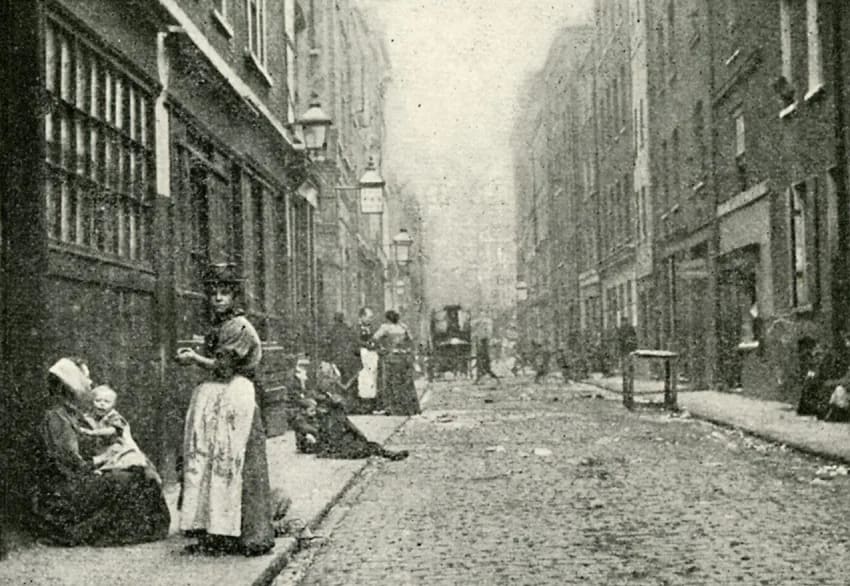
This was Whitechapel in 1888: not a gothic stage set created by later storytellers, but a real working-class neighbourhood under extreme pressure. Understanding Victorian Whitechapel is essential if you want to understand the Whitechapel murders properly. If you want to experience the geography on the ground, our Jack the Ripper Free Walking Tour explores the streets where this history unfolded.
How Whitechapel Became One of London's Worst Slums
Whitechapel was not always synonymous with deprivation. In earlier centuries it lay just beyond the City of London walls, semi-rural and relatively modest. Small trades, market gardens, and local industries defined the area.
The transformation began in the eighteenth century and accelerated with the Industrial Revolution. Less desirable industries — tanneries, foundries, breweries, and slaughterhouses — clustered in the East End. These businesses required labour, and labourers needed cheap housing. Property owners subdivided buildings, erected low-quality tenements, and packed families into ever tighter spaces. As London's docks expanded, thousands of workers arrived seeking employment. By 1888, Whitechapel had gained a reputation among wealthier Londoners as a place to avoid entirely.
Living Conditions in Whitechapel 1888
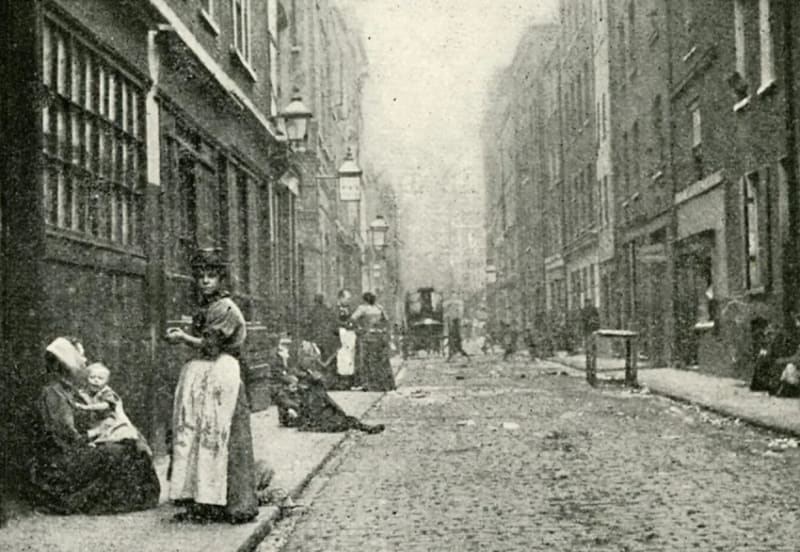
To understand life in Victorian Whitechapel, you have to start with housing. Overcrowding was extreme. Entire families often shared a single room, and multiple families might occupy a building originally designed for one household. Ventilation was poor, natural light limited, and privacy almost non-existent.
Common lodging houses became central to the district's survival economy. For fourpence, a person could rent a bed for the night. For less, they might sleep sitting upright, supported by a rope stretched across a room. More than 8,000 people relied on these lodging houses nightly in Whitechapel alone. Several of the canonical five Jack the Ripper victims lived this way, moving from one bed to the next as money allowed.
Sanitation compounded the hardship. Modern sewerage systems were incomplete, and waste accumulated in courts and alleyways. Contaminated water, overcrowding, and malnutrition fuelled outbreaks of tuberculosis, typhoid, and cholera. Child mortality rates were shockingly high, and a heavy coal smoke haze hung over the East End for much of the year.
Poverty, Prostitution, and Survival
Employment in Victorian Whitechapel was unstable and often brutal. Dock labourers might queue for hours hoping to be selected for a single day's work. Factory conditions were harsh and poorly regulated. Tailoring sweatshops paid by piecework, forcing long hours for minimal income.
Women faced even fewer options. With little access to stable employment, many turned to casual prostitution to afford food or a bed for the night. The Metropolitan Police estimated that approximately 1,200 women were working as prostitutes in Whitechapel in October 1888. Most operated independently, negotiating short encounters for small sums. This economic vulnerability is central to understanding the Whitechapel murders — the victims were not random passers-by, but women navigating poverty in one of London's most unforgiving districts.
Crime and Policing in Victorian Whitechapel
Whitechapel's reputation for crime long predated Jack the Ripper. Petty theft, assault, and gang activity were common. Alcohol consumption was high, and violence spilled from public houses into the streets. The layout of the district — narrow alleys, enclosed yards, and multiple escape routes — made policing difficult.
The police force itself was still developing. Resources were limited, forensic science was rudimentary, and communication was slow. Complicating matters further, the boundary between the Metropolitan Police and the City of London Police ran directly through the area — a jurisdictional divide that becomes particularly relevant in the Jack the Ripper case, especially on the night known as the Double Event.
Immigration and Tension in the East End
Victorian Whitechapel was one of the most culturally diverse districts in London. Waves of migration shaped the East End throughout the nineteenth century, bringing resilience, entrepreneurship, and cultural richness — but also overcrowding, economic competition, and rising tension.
Irish Immigrants in Victorian Whitechapel
Large numbers of Irish migrants arrived following the Great Famine of the 1840s. Many settled in the East End, where rents were cheapest and dock work was available, though rarely stable. Irish communities became closely associated with manual dock labour, railway construction, and factory work. Poverty and overcrowding fuelled negative stereotypes, though these were not unique to Irish communities.
Jewish Immigrants and Rising Anti-Semitism
From the 1880s onwards, Whitechapel and Spitalfields saw significant arrivals of Jewish immigrants fleeing persecution and pogroms in Russia and Eastern Europe. Many found work in tailoring, cobbling, and small-scale manufacturing. Synagogues, Yiddish theatres, and community networks developed rapidly across the district.
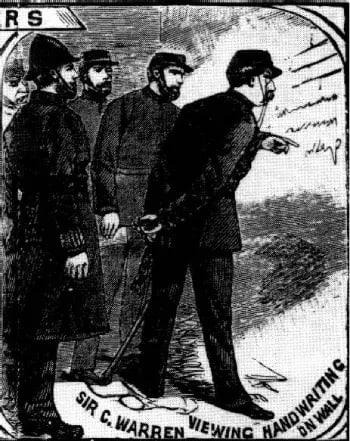
During the Jack the Ripper murders, suspicion quickly turned toward Jewish residents. The chalked message discovered in Goulston Street after the murder of Catherine Eddowes — widely known as the Goulston Street graffito — was erased by police in the early hours, partly out of fear it could incite anti-Jewish riots. Immigration did not create the poverty of Whitechapel, but it heightened tensions in a district already struggling under economic and social strain.
Social Reform and Whitechapel
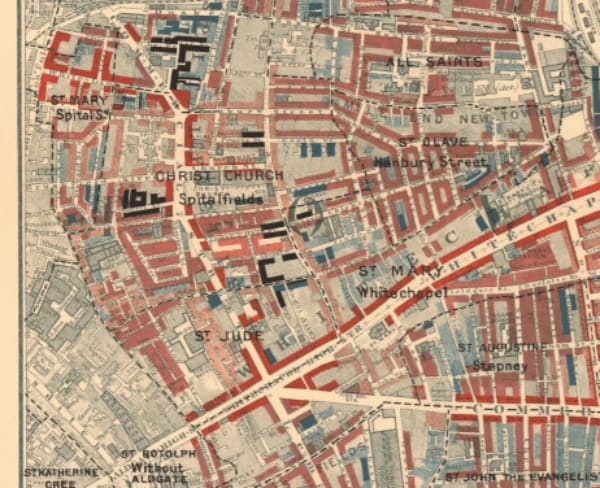
The conditions in Victorian Whitechapel shocked reformers and helped ignite social change across Britain. Charles Booth's poverty maps in the 1890s colour-coded London's streets by income level, and Whitechapel appeared overwhelmingly in the darkest shades. His research exposed the scale of urban deprivation to a middle-class audience that had rarely seen it firsthand.
William Booth founded the Salvation Army in Whitechapel in 1878, combining religious mission with practical support for the destitute. Dr Barnardo opened homes for vulnerable children in the East End. Reform did not immediately transform Whitechapel, but it laid the groundwork for changes that would shape public health policy, housing regulation, and social welfare in the decades that followed.
What Survives from Victorian Whitechapel Today
Modern Whitechapel looks very different from the district of 1888. Slum clearance, redevelopment, and regeneration have transformed much of the area. Yet traces of Victorian Whitechapel remain if you know where to look.
Christ Church Spitalfields still stands, the white tower that dominated the skyline in 1888. The Ten Bells pub on Commercial Street, connected to both Annie Chapman and Mary Jane Kelly, still operates. Gunthorpe Street, formerly George Yard, is still cobbled and accessible through the same archway as in 1888. The Royal London Hospital, where Emma Smith died and Dr Openshaw worked during the Ripper investigation, remains on Whitechapel Road. Walking the streets today, you can trace the outline of Victorian Whitechapel within a compact area that can be covered on foot in under an hour.
Final London Insiders Tip
Whitechapel in Victorian London was not a gothic Ripper set. It was a real, overcrowded neighbourhood shaped by poverty, unstable work, migration, and streets that were difficult to police even on an ordinary night. When you understand that environment, the Whitechapel murders stop feeling like a mystery dropped into nowhere and start making sense as a story shaped by place. Join our Jack the Ripper Free Walking Tour and explore the social conditions, the surviving architecture, and the real streets where this history unfolded.

Whitechapel in Victorian London was one of the poorest districts in the British Empire. Overcrowding, unemployment, poor sanitation, and high crime rates defined daily life. Thousands lived in common lodging houses, and an estimated 1,200 women worked as prostitutes in 1888.
Whitechapel's poverty resulted from rapid industrialisation, mass immigration, casual dock labour employment, and inadequate housing infrastructure. Cheap tenements became overcrowded, sanitation deteriorated, and unemployment remained high throughout the Victorian era.
Hundreds of thousands lived in London's East End in the 1880s, with a large proportion concentrated in Whitechapel. Over 8,000 people slept in common lodging houses each night, and thousands more lived in single-room tenements.
Yes. Although much has changed, several Victorian buildings survive and the original street layout remains largely intact. Christ Church Spitalfields, the Ten Bells pub, Gunthorpe Street, and the Royal London Hospital all date from or connect to the Victorian era.
There are no large official memorials marking the canonical five sites. However, a small memorial plaque for Catherine Eddowes can be found in Mitre Square, close to where her body was discovered.