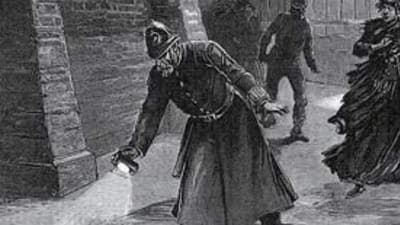
- 01Victorian London Daily Life: Two Cities in One
- The West End: Stability and Privilege
- The East End: Survival and Instability
- 02Crime in Victorian London
- 03The Birth of Scotland Yard
- The Criminal Investigation Department — 1878
- 04Early Forensic Science and Its Limits
- 05Why the Jack the Ripper Investigation Failed
- 06The Role of the Victorian Press
- 07Punishment and Justice in Victorian London
- 08How Victorian London Crime Shaped Modern Policing
- 09Final London Insiders Tip
Victorian London crime in 1888 was not a gothic myth. It was shaped by rapid industrial change, extreme economic inequality and a policing system still finding its way in a city growing faster than anyone knew how to govern. Understanding why the crimes of 1888 looked the way they did — and why the most famous of them was never solved — requires understanding what Victorian London was actually like to live in.
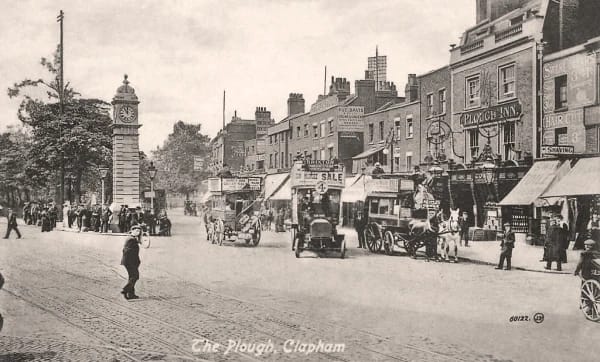
This guide covers Victorian London daily life and crime, the birth of Scotland Yard, the limits of early forensic science, and what the Jack the Ripper investigation exposed about the policing of the era. For the murders themselves in detail, our Jack the Ripper Timeline covers the canonical five. For the conditions that shaped Whitechapel specifically, our Whitechapel in Victorian London guide goes into depth.
Victorian London Daily Life: Two Cities in One
Victorian London daily life depended almost entirely on class and geography. The city was effectively two overlapping worlds that happened to share the same streets.
The West End: Stability and Privilege
In Mayfair, Belgravia and Kensington, wealthy families lived in multi-storey townhouses with servants. Streets were better maintained and better lit. By the late nineteenth century, sewer systems and clean water infrastructure had improved significantly in these districts. Upper-class society revolved around private clubs, theatres and the London Season. Crime existed but rarely entered daily consciousness. Policing was preventative and largely invisible.
The East End: Survival and Instability
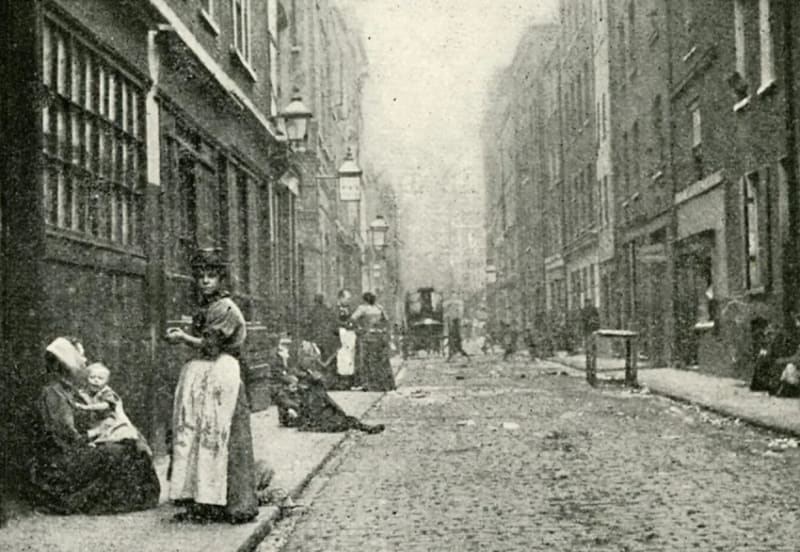
In the East End, life was defined by instability. Families crowded into single rooms. Shared outdoor toilets served entire buildings. Dock labourers waited daily for casual work that might last only a few hours. Women had fewer opportunities still. Domestic service and laundry work paid poorly. Many turned to casual prostitution simply to afford a bed in a common lodging house — fourpence a night, which could be the difference between sleeping indoors or on the street. By 1888, an estimated 1,200 women were working in Whitechapel alone under these conditions. The five women in the Jack the Ripper timeline all lived within this fragile economic system. Victorian London crime cannot be separated from these living conditions.
Crime in Victorian London
Crime in Victorian London ranged from petty theft to sensational murder. Petty crime — pickpocketing, shoplifting, small-scale fraud — accounted for the majority of reported offences. Crowded markets and railway stations provided ideal environments for opportunistic theft. Violent crime was statistically less common but carried enormous public impact. Assault, gang fights and alcohol-related violence were frequent in poorer districts. Murder was rare but highly publicised, particularly when it occurred in areas already associated with disorder.
Economic inequality played a central role in all of this. Where housing was overcrowded and employment insecure, Victorian London crime rates were higher. In districts like Whitechapel, narrow courts and poorly lit streets made policing particularly difficult. The area had more places to disappear into than any organised patrol could realistically cover.
The Birth of Scotland Yard
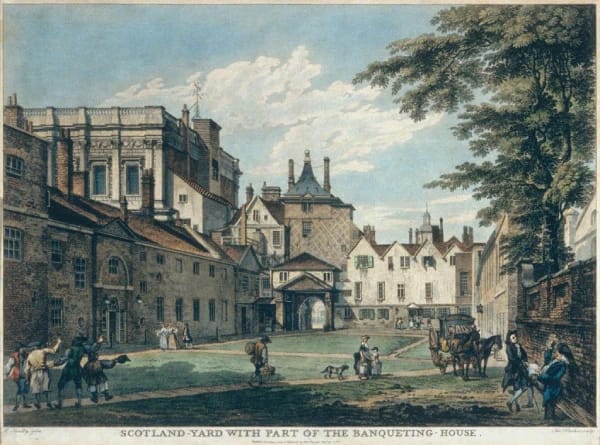
Before 1829, London had no organised professional police force. Law enforcement relied on parish constables and night watchmen — a fragmented, inconsistent system entirely ill-suited to a rapidly expanding industrial city. In 1829, Home Secretary Sir Robert Peel founded the Metropolitan Police, establishing what would become known as Scotland Yard. Officers, nicknamed Bobbies or Peelers after Peel, focused primarily on crime prevention through visible patrol. The idea was that a police presence would deter crime before it happened, rather than investigate it after. Public reaction was mixed. Some feared state overreach; others welcomed the improved security in an increasingly crowded city.
The Criminal Investigation Department — 1878
By 1878, the need for dedicated detectives led to the creation of the Criminal Investigation Department, or CID. Unlike uniformed officers, CID detectives worked in plain clothes and focused on solving crimes after they occurred. By 1888 the department remained small and overstretched. When the Jack the Ripper investigation began, Scotland Yard faced enormous pressure with limited manpower and almost no forensic technology.
Early Forensic Science and Its Limits
Victorian London crime was investigated without most of the tools modern detectives consider essential. Fingerprinting was not introduced at Scotland Yard until 1901, more than a decade after the Whitechapel murders. DNA analysis, CCTV and organised forensic laboratories did not exist. Medical examiners could analyse wounds and identify some poisoning cases through toxicology, but crime scene preservation was inconsistent. Photography was emerging and some of the mortuary images from the Ripper investigation survive because of these early practices, making them among the oldest crime scene photographs in British history. Detectives relied on witness statements, patrol patterns and local knowledge. In a dense district like Whitechapel, that was often not enough.
Why the Jack the Ripper Investigation Failed
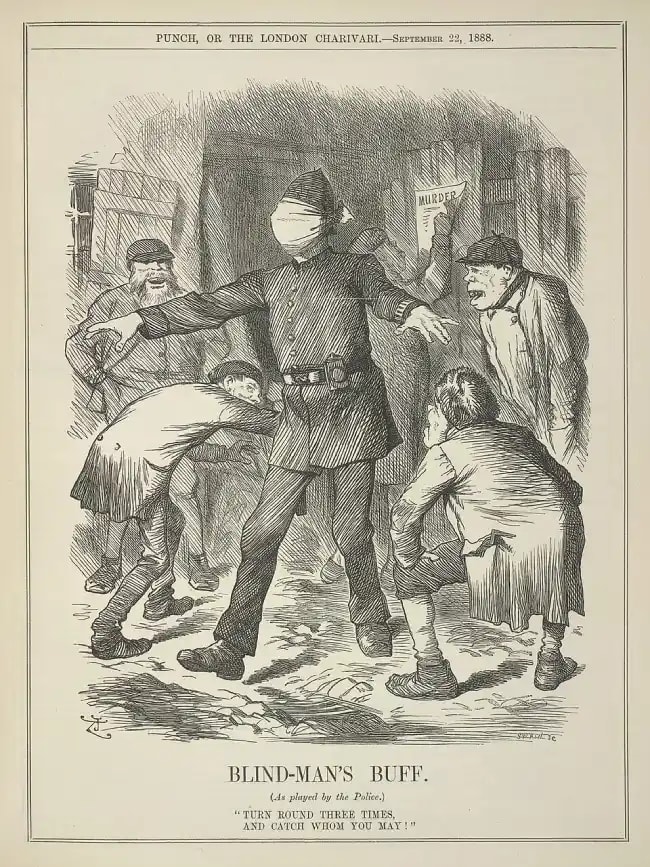
The Jack the Ripper investigation exposed the weaknesses of Victorian policing more clearly than any previous case. Officers conducted thousands of interviews, increased patrols dramatically and investigated hundreds of individuals. Yet they faced jurisdictional complications between the Metropolitan Police and the City of London Police — a boundary that became directly relevant when Catherine Eddowes was killed in Mitre Square, which sat in the City's jurisdiction. Witness descriptions conflicted. Streets were poorly lit. Escape routes were numerous. The killer appeared to have no prior relationship with his victims, which removed the most common investigative starting point. Without fingerprints or reliable forensic evidence, detectives were left piecing together fragments. The system was not equipped to catch a stranger who moved quickly through a densely packed district and left no clear trail.
The Role of the Victorian Press
The Victorian press shaped public perception of the Whitechapel murders dramatically. Newspapers competed fiercely for readership, and sensational crime stories sold copies. The name "Jack the Ripper" originated from a letter sent to the Central News Agency in September 1888 — almost certainly a journalistic hoax. Once published, it created a brand that newspapers amplified without restraint. Newspapers criticised Scotland Yard openly and frequently, driving public confidence in the police down even as the investigation was producing genuine results. The relationship between media and criminal investigation, still debated today, was forged in large part during this period of Victorian London crime reporting.
Punishment and Justice in Victorian London
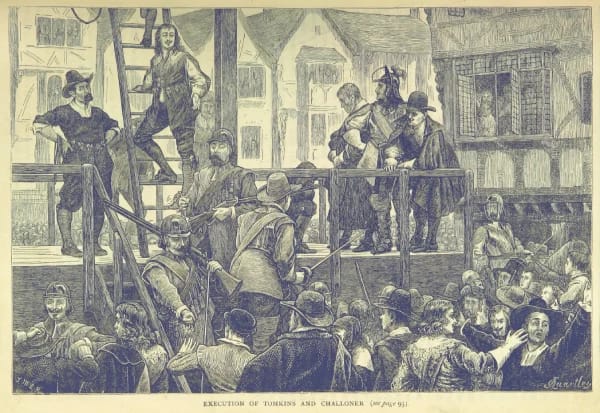
Victorian justice was severe. Public executions continued until 1868 and attracted large crowds — they were treated as public spectacle. After 1868, hangings moved inside prison walls but remained common. Transportation, hard labour and long prison sentences were standard punishments for theft and assault. Workhouses housed the destitute under harsh conditions designed to be unpleasant enough to deter people from seeking them. By the late Victorian era, reformers were beginning to question whether punishment alone reduced crime, and the debate between deterrence and rehabilitation was already taking shape.
How Victorian London Crime Shaped Modern Policing
The challenges faced in nineteenth-century London laid real foundations for modern policing. Scotland Yard proved that organised, professional law enforcement could function at scale. The CID demonstrated the importance of specialised investigation separate from uniformed patrol. The failures during the Jack the Ripper investigation highlighted the need for improved forensic science, systematic record-keeping and coordination between jurisdictions. Many principles of modern criminal investigation developed in direct response to what went wrong in 1888. The Metropolitan Police today operates in ways that trace a direct line back to the lessons of that era.
Final London Insiders Tip
When you understand the social conditions of Victorian Whitechapel — the poverty, the overcrowding, the policing limits, the jurisdictional boundaries, the absence of forensic tools — the Jack the Ripper investigation feels less like an unsolvable legend and more like a case shaped entirely by its time. If you want to see where all of this happened, our Jack the Ripper Free Walking Tour walks the streets of 1888 Whitechapel and places the history back in its physical setting.
Victorian London crime ranged from widespread petty theft and pickpocketing to violent assault and murder. Most reported offences were minor property crimes. Districts like Whitechapel experienced higher violent crime due to poverty, overcrowding and limited policing resources.
Crime was higher in the East End because of extreme poverty, unstable employment and overcrowded housing. Poor lighting and maze-like streets in Whitechapel made policing difficult and gave criminals easy escape routes.
Scotland Yard used uniformed patrol officers and plain-clothes CID detectives. Investigations relied on witness statements, door-to-door enquiries and medical examinations. Fingerprinting and DNA analysis did not yet exist in 1888.
No. Scotland Yard did not establish its Fingerprint Bureau until 1901, more than a decade after the Jack the Ripper investigation. In 1888, detectives relied mainly on witness testimony and physical observation.
The investigation lacked modern forensic tools, faced jurisdictional complications between two police forces, and was dealing with a killer who appeared to have no prior connection to his victims. The system of the era was not equipped to catch a stranger in a dense, poorly lit district who left minimal traceable evidence.
High-profile Victorian cases exposed weaknesses in early policing and pushed Scotland Yard to improve detective training, forensic methods and inter-jurisdictional coordination. Many principles of modern criminal investigation developed in response to the failures of nineteenth-century methods.