- 01Why the Canonical Five?
- 0231 August 1888: Mary Ann Nichols
- 038 September 1888: Annie Chapman
- 0430 September 1888: The Double Event
- Elizabeth Stride — 1:00am, Dutfield's Yard
- Catherine Eddowes — 1:45am, Mitre Square
- 059 November 1888: Mary Jane Kelly
- 06The Wider Whitechapel Murders
- 07What Was Whitechapel Like in 1888?
- 08Final London Insiders Tip
The Jack the Ripper timeline is one of the most studied and debated sequences of murders in modern criminal history. In the autumn of 1888, five women were killed in London's East End in crimes that shocked Victorian society, exposed the realities of poverty in Whitechapel, and remain unsolved to this day. Between August 31 and November 9, 1888, a pattern emerged — escalating brutality, geographical clustering, and mounting public hysteria. These murders became known as the Whitechapel murders, and the killer was given the name "Jack the Ripper".
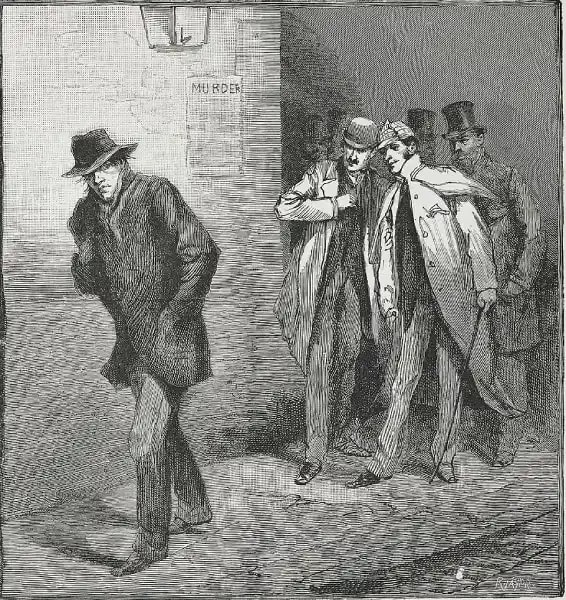
This guide follows the Jack the Ripper murders in order, outlining the canonical five victims, the key dates, and the context surrounding each death. If you want to understand how close these locations really are, our Jack the Ripper Free Walking Tour walks the same streets and places the timeline back into its physical setting.
Why the Canonical Five?
Between 1888 and 1891, eleven women were murdered in Whitechapel and surrounding districts. So why do historians focus on five? Because the method, timing, and escalation link them clearly. The five canonical victims were killed between late August and early November 1888, had their throats cut, suffered abdominal mutilations of increasing severity, were killed outdoors or in semi-public spaces, and all lived in extreme poverty in Whitechapel. These similarities form the core of the Whitechapel murders timeline.
31 August 1888: Mary Ann Nichols
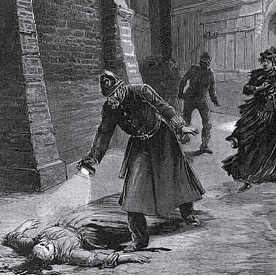
Mary Ann Nichols, known as Polly, was found at approximately 3:40am in Buck's Row (now Durward Street). Her body was discovered by Charles Cross, a carman walking to work. He initially thought she was simply lying drunk on the pavement — a common sight in Whitechapel at the time. Polly Nichols was 43. She had been living in common lodging houses and had reportedly been turned away earlier that night for not having fourpence for a bed.
Nichols' throat had been cut twice, the second cut deeply enough to almost sever the head. Her abdomen had been slashed multiple times. The brutality stood out immediately — this was not a simple robbery or street fight. The abdominal wounds suggested the killer remained at the scene for at least a short period after death. Mary Ann Nichols is widely recognised as the first victim in the Jack the Ripper timeline. The murder scene on Buck's Row is still accessible today and forms a key stop on the Jack the Ripper walking route.

8 September 1888: Annie Chapman
Annie Chapman was found at around 6:00am in the backyard of 29 Hanbury Street, Spitalfields. Chapman was 47 and had also been living in lodging houses. She had been turned away that night for failing to pay her bed fee. Witnesses reported seeing her speaking with a man around 5:30am — less than half an hour before her body was discovered. Hanbury Street in 1888 was densely populated. That the murder took place so close to sleeping residents added to the growing panic.
Chapman's throat had been cut deeply. Her abdomen had been opened and organs removed. Dr George Bagster Phillips, who examined the body, suggested the killer acted with speed and a degree of familiarity with anatomy — whether this meant medical training or practical experience remains debated. What cannot be debated is the escalation. The injuries were more extensive than those inflicted on Nichols. This murder transformed the case. Newspapers intensified coverage, public fear surged, and vigilance committees formed in Whitechapel. It was after Chapman's murder that letters signed "Jack the Ripper" began reaching the press — the moment the Whitechapel murders moved from local horror to international obsession.

30 September 1888: The Double Event
The night of 30 September stands as one of the most striking chapters in the Jack the Ripper timeline. Two murders. Roughly 45 minutes apart. Less than a mile between them.
Elizabeth Stride — 1:00am, Dutfield's Yard
Elizabeth Stride, known as Long Liz, was discovered at approximately 1:00am in Dutfield's Yard off Berner Street (now Henriques Street). She was 44 years old and had been living in a common lodging house on Flower and Dean Street. Earlier that evening she had been seen speaking with a man near the entrance to the International Working Men's Educational Club. Louis Diemschutz, a steward at the club, discovered her body when his cart entered the yard and his horse shied unexpectedly.
Unlike the previous victims, Stride's injuries were limited to a single deep cut across the throat. There were no abdominal mutilations. The prevailing theory among historians is interruption: if the killer was still present when Diemschutz arrived, he would have had only seconds to escape into the darkness of Berner Street. If Stride was indeed a Ripper victim, her murder represents a failed attack — cut short before the mutilations that had come to define the series.
Catherine Eddowes — 1:45am, Mitre Square
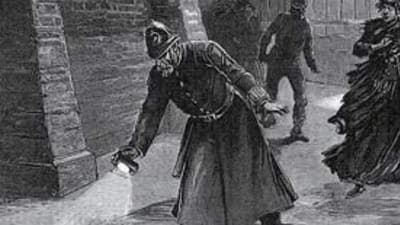
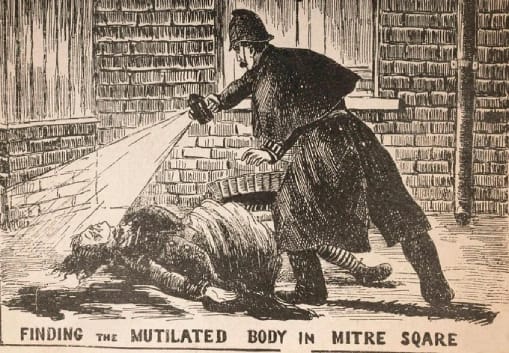
Just forty-five minutes after Stride's body was discovered, Catherine Eddowes was found murdered in Mitre Square — nearly a mile away and within the jurisdiction of the City of London Police rather than the Metropolitan Police. Eddowes was 46 years old. Earlier that night she had been arrested for drunkenness and taken to Bishopsgate Police Station. She was released at approximately 1:00am and was last heard saying she intended to return to her lodgings.
At 1:30am, PC Edward Watkins patrolled Mitre Square and saw nothing unusual. When he returned at 1:45am, Eddowes' body lay in the south-west corner. The injuries were the most extensive yet: throat cut, abdomen opened, organs removed, face slashed. A piece of her apron had been cut away and was later found in Goulston Street beneath a chalked message: "The Juwes are the men that will not be blamed for nothing." Fearing anti-Semitic riots in the already tense East End, police ordered the writing erased before dawn — a decision that remains controversial among Ripper scholars. The speed between Stride and Eddowes' murders is one of the most chilling elements of the Jack the Ripper timeline. If the same man committed both crimes, it suggests confidence, mobility, and intimate knowledge of Whitechapel's streets.
9 November 1888: Mary Jane Kelly
Mary Jane Kelly was found murdered in her small rented room at 13 Miller's Court, off Dorset Street, at approximately 10:45am. Kelly was around 25 years old — significantly younger than the other victims — and unlike the previous murders, she was killed indoors in the privacy of her own room. Her landlord had sent an assistant, Thomas Bowyer, to collect overdue rent. Unable to receive a response, Bowyer looked through the broken window and saw Kelly's body. A neighbour later reported hearing a faint cry of "murder" at around 4:00am, but such cries were common in Whitechapel and no one investigated.
What police found inside Miller's Court was beyond anything previously seen in the case. Kelly's body had been extensively and systematically mutilated. Because the murder occurred indoors, the killer had time — something he had never previously had in outdoor attacks. The privacy of the room removed the constant risk of interruption. Police photographs taken at the scene still exist and remain some of the most disturbing crime scene images in British criminal history. After Kelly's murder, the killings stopped abruptly. No further murders matching the same pattern occurred. Whether the killer died, was imprisoned, institutionalised, or emigrated remains unknown. The sudden stop is as mysterious as the crimes themselves.

The Wider Whitechapel Murders
The Metropolitan Police investigation file covered eleven murders between 1888 and 1891, collectively known as the Whitechapel murders. Among them: Emma Smith (attacked April 1888, assaulted by multiple men rather than a lone attacker) and Martha Tabram (August 7, 1888, stabbed 39 times but not mutilated in the same manner as later victims). While some researchers argue that Martha Tabram may have been an early Ripper victim, the differences in method make definitive inclusion difficult. The consistency of method, the escalation of mutilations, and the tight geographic clustering set the canonical five apart within the broader Whitechapel murders timeline.
What Was Whitechapel Like in 1888?
To understand the Jack the Ripper timeline, you need to understand Whitechapel itself. In 1888, this part of London's East End was one of the most overcrowded and impoverished areas in the city. Tens of thousands of people lived in narrow streets packed with common lodging houses, sweatshops, casual labourers, and newly arrived immigrants. Work was unstable, lighting was poor, policing was stretched thin, and violence was not uncommon. Women often relied on casual prostitution simply to afford a bed for the night — usually fourpence in a lodging house. Our guide to Whitechapel in Victorian London covers this world in full.
Final London Insiders Tip
The Jack the Ripper timeline makes logical sense when written in order. But it becomes far more unsettling when you realise how close these streets are to one another. Whitechapel today is busy and modern. In 1888 it was dark, crowded, and desperate. If this timeline has sparked your interest, our Jack the Ripper Free Walking Tour brings the case back into its physical setting — where the distances, environment, and unanswered questions feel very different from reading them on a page.
The widely accepted number is five, known as the canonical five: Mary Ann Nichols, Annie Chapman, Elizabeth Stride, Catherine Eddowes, and Mary Jane Kelly.
The canonical murders occurred between 31 August and 9 November 1888 — a ten-week period in the autumn of 1888.
All five canonical murders occurred in Whitechapel and Spitalfields in London's East End, including Buck's Row, Hanbury Street, Dutfield's Yard, Mitre Square, and Miller's Court.
The Metropolitan Police opened a file titled "Whitechapel Murders" covering violent deaths between 1888 and 1891. The canonical five fall within that investigation.
There is no confirmed explanation. Theories include death, imprisonment, mental illness, or relocation. No definitive evidence identifies the killer or explains the abrupt end.