
Westminster is one of the most compact yet historically dense areas of London. Within a short walking distance, you can trace the story of monarchy, religion, politics, protest, and everyday London life, all layered on top of one another.
This self-guided walking route is designed for visitors who want to explore Westminster independently and understand the history and landmarks without rushing. It follows a logical, mostly flat route and works equally well for first-time visitors and those returning who want deeper context.
How this Westminster walking route works
This self-guided route takes around two to two and a half hours, covers approximately 2.5 kilometres, is mostly flat and accessible, and follows a natural west-to-east flow through Westminster. You can complete the walk at your own pace, stopping where you like and skipping sections if needed. If you would prefer a guide, this route closely mirrors the Westminster Free Walking Tour, which covers the same area with stories and local insight.
Stop 1: Buckingham Palace
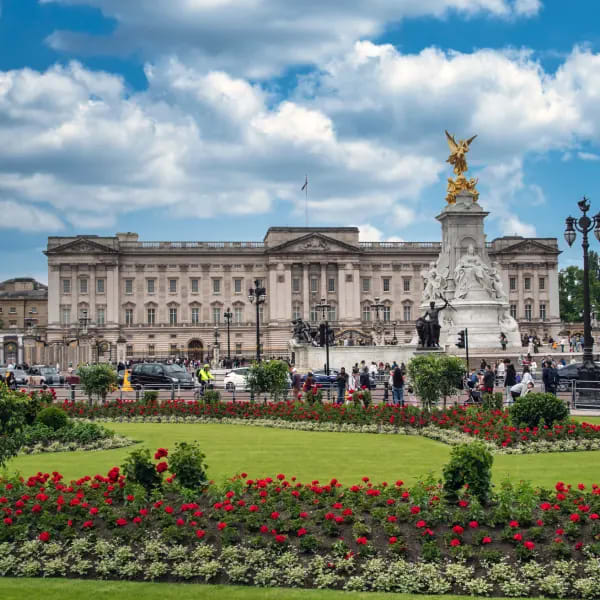
Start at Buckingham Palace, the official London residence of the British monarch. Take time to explore the palace gates, forecourt, and surrounding area. If you arrive late morning on certain days, you may witness the Changing of the Guard.
Before you do anything else, look at the flag above the palace. The Royal Standard means the King is in London. The Union Jack means he is away. Most visitors never think to check — and it tells you something immediate about the building in front of you.
To understand how Buckingham Palace evolved from a private townhouse into the ceremonial heart of the monarchy, see the Buckingham Palace History and Visiting Guide.
Stop 2: St James's Park
From Buckingham Palace, walk directly into St James's Park, one of London's oldest royal parks. The park offers a welcome pause early in the route, with open paths and lakeside views. Keep an eye out for the resident pelicans, which have lived in the park since the seventeenth century.
We recommend crossing the Blue Bridge — the views toward Whitehall from there are exceptional and often missed by visitors. St James's Park Café is a good spot for coffee if you want to slow down before continuing.
Most visitors rush through St James's Park looking at their maps. Stop at the Blue Bridge and look north toward Whitehall — the view of the government buildings framed by trees and water is one of the most photographed scenes in London, and most people walk straight past it.
Allow 30 to 45 minutes.
Stop 3: Horse Guards Parade
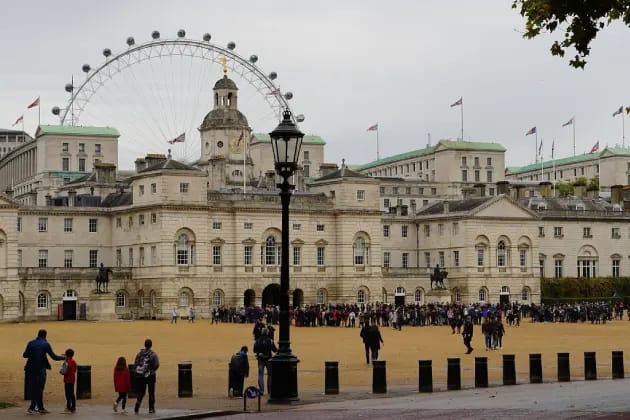
Exit the park at Horse Guards Parade, a large ceremonial square used for royal events, military parades, and state occasions. This is one of the best places in Westminster to see the Royal Guards close up, especially when mounted guards are on duty. The archway beneath the Horse Guards building forms the official ceremonial entrance connecting St James's Palace and Buckingham Palace — which is why guards are stationed here at all times. Do not step inside the white painted boxes on the ground; these mark the guards' working area.
Stop 4: Whitehall
Whitehall has been the centre of British government for centuries. As you walk along it, you pass buildings connected to major political decisions, wartime leadership, and modern governance. Just off Whitehall sits 10 Downing Street, the official residence of the Prime Minister. While the street itself is gated, standing nearby gives a sense of how compact and concentrated political power is in Westminster. Whitehall acts as the bridge between royal Westminster and political Westminster.
Stop 5: Parliament Square
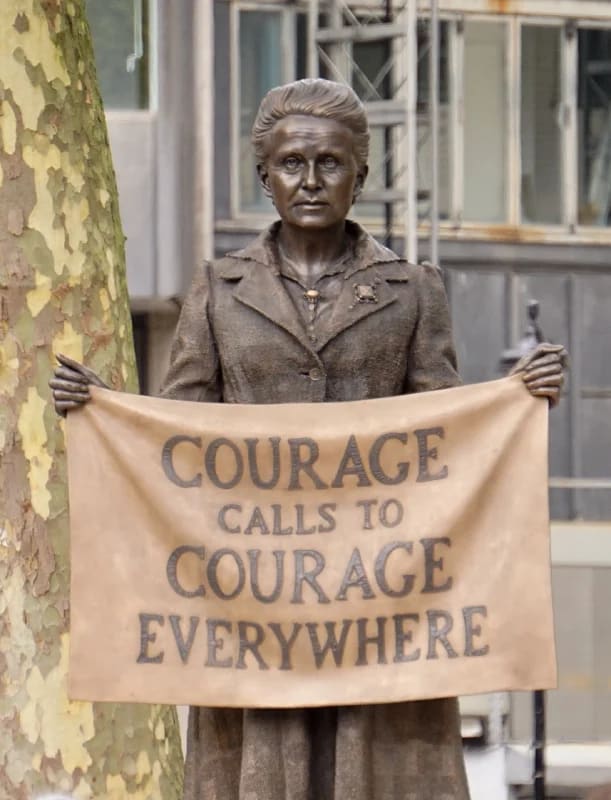
At the southern end of Whitehall, you arrive at Parliament Square, one of the most symbolically important public spaces in the UK. The square is surrounded by institutions of power but has also long been a place for protest and public expression. One statue to notice is Millicent Garrett Fawcett, a leading figure in the women's suffrage movement. She campaigned peacefully for women's right to vote, and her statue was the first in Parliament Square to honour a woman.
Stop 6: Houses of Parliament and Big Ben
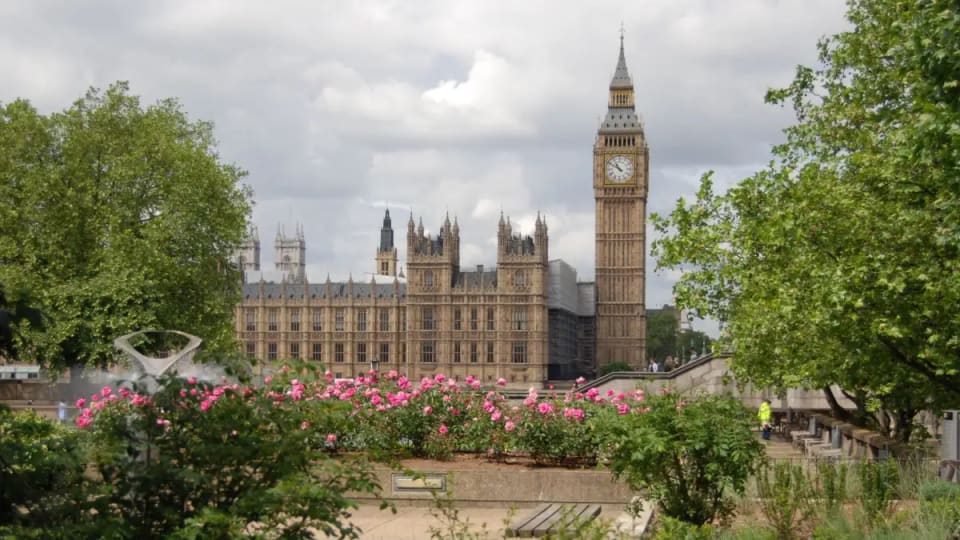
From Parliament Square, walk toward the Houses of Parliament, officially known as the Palace of Westminster. This is where the House of Commons and House of Lords meet to debate and shape British law. While the building looks medieval, much of what you see today dates from the nineteenth century, after the devastating fire of 1834. One major survivor was Westminster Hall, dating back to the eleventh century.
The Elizabeth Tower beside Parliament is often called Big Ben — but Big Ben is actually the name of the bell inside the tower. You can visit Parliament for free by attending a debate in the public galleries. The Houses of Parliament History and Facts guide explains how this works.
Westminster Hall — the oldest surviving part of Parliament, built in 1097 — is free to enter when Parliament is in session. Access is through St Stephen's Gate. Most visitors queue outside Parliament assuming everything costs money. Westminster Hall doesn't. It's one of the most important rooms in British history.
Stop 7: Westminster Abbey
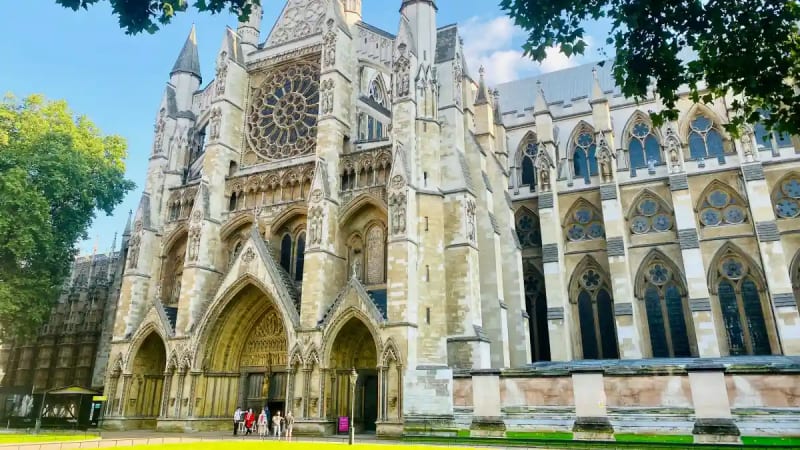
End your walk at Westminster Abbey, one of the most important religious buildings in Britain. The Abbey has been the site of coronations since 1066 and is closely linked to royal ceremonies and national events. Kings, queens, writers, scientists, and political figures are buried or commemorated here, making it a living record of British history.
Optional extras
If you have more time, consider visiting The Westminster Arms, a historic pub just behind Parliament. This pub famously had a division bell installed so MPs would have eight minutes to finish their drink and make it back to Parliament in time to vote. It is one of only six pubs in London with a division bell still installed. You can also extend the walk along the River Thames or revisit St James's Park at a slower pace.
The best way to experience Westminster is not by jumping between individual landmarks, but by seeing them as part of one continuous story. When you follow this route from Buckingham Palace through St James's Park, Whitehall, Parliament, and Westminster Abbey, the area starts to make sense as a whole. If you want stories, context, and local insight as you go, join our Westminster Free Walking Tour.

