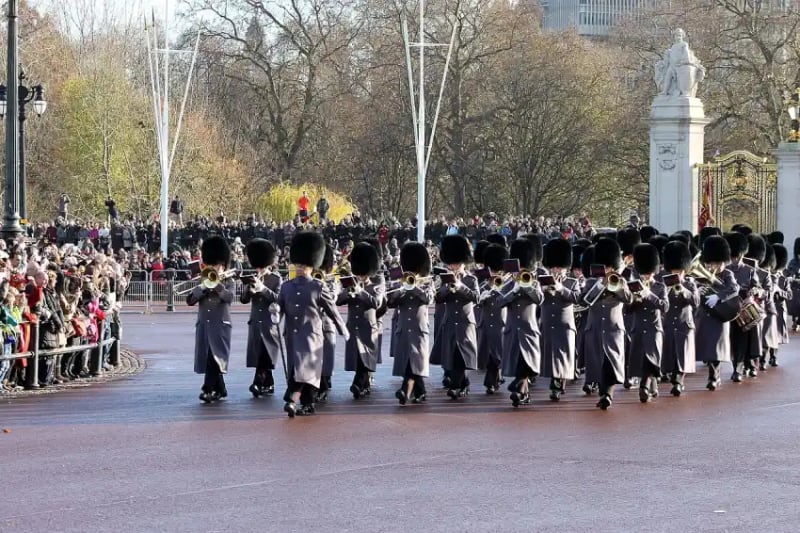
The Changing of the Guard is one of the most recognisable ceremonies in the world, but most visitors watch it from the wrong place. The standard approach is to head to Buckingham Palace and wait at the gates. What you see from there is largely the tops of bearskin hats at a distance, with the actual ceremony taking place behind iron railings that neither the angle nor the crowd allows you to see properly.
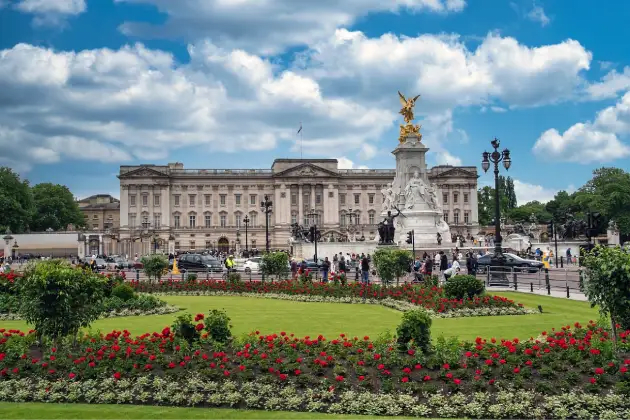
The ceremony is bigger than most people realise. It spans five distinct locations, involves two separate processions, a regimental band, the King's Life Guard on horseback, and a final handover at St James's Palace where you can stand at arm's length from the guard with no barriers, no crowds, and no railings in the way. Most visitors miss all of that.
Who are the King's Guard?
The soldiers in scarlet tunics and bearskin hats are not performers. They are serving members of the British Army who rotate between ceremonial duties in London and operational deployments abroad. The weapons they carry are loaded.
Five regiments make up the Foot Guards.
Identify the regiment by their buttons: Grenadier Guards wear them singly, Coldstream in pairs, Scots in threes, Irish in fours, Welsh in fives. This is infallible from a distance.

The Ceremonies: What Is Actually On and When
The Changing of the Guard consists of three distinct public ceremonies each week.
Main Guard Change
Takes place on Mondays, Wednesdays, and Fridays at 11:00am. This is the full ceremony: regimental band, marching soldiers, formal handover of the palace keys. Troop movements begin around 10:30am and the whole sequence takes approximately one hour from first movement to final completion.
Captain's Inspection
Tuesdays, Thursdays, and Saturdays at 3:00pm. Smaller scale, quieter, no band. Crowds are noticeably thinner and the atmosphere is calmer. Worth knowing about if the main ceremony schedule does not fit your plans.
Sunday Parade
The least well-known ceremony and the least crowded. It starts earlier than the main weekday ceremony and follows a different sequence. If you have flexibility, Sunday is the best day to attend.
Always check the official Household Division calendar before visiting. The ceremony cancels at short notice for heavy rain and state occasions.
Why Most Visitors Get the Changing of the Guard Wrong
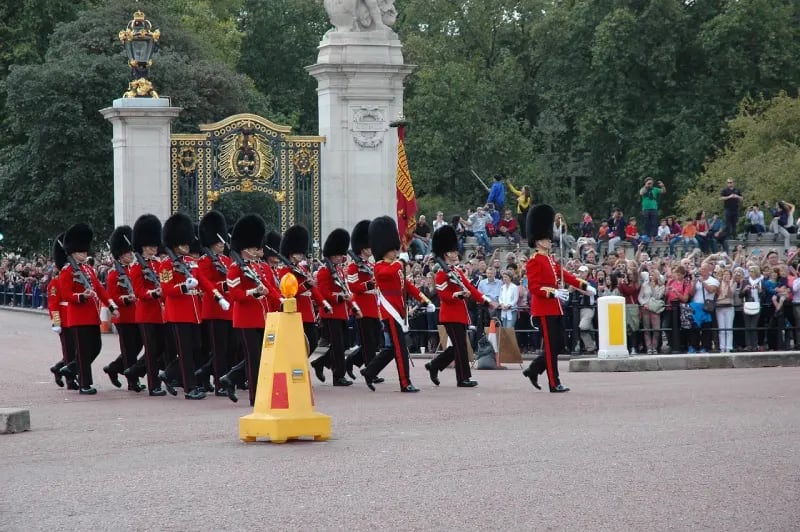
Going directly to Buckingham Palace and waiting at the gates seems logical. The ceremony is named after the palace. The problem is that what happens behind those gates is the most static and visually restricted section of the whole morning. The handover, the key exchange, and the formation work all take place at distance, behind iron railings, with large numbers of people in the way.
To get a decent position at peak season you need to arrive before 10:00am. Once you are there, leaving means losing your spot. You will watch bearskin hats at middling distance with a band you can only partially hear.
Meanwhile, the genuinely spectacular moments happen in open street: the marching, the music at close range, the sound of boots on the road as the regiment turns corners directly in front of you. Most people standing at the palace gates miss all of this entirely.
The Best Place to See the Changing of the Guard
The best viewing location is not at Buckingham Palace. It is at St James's Palace.
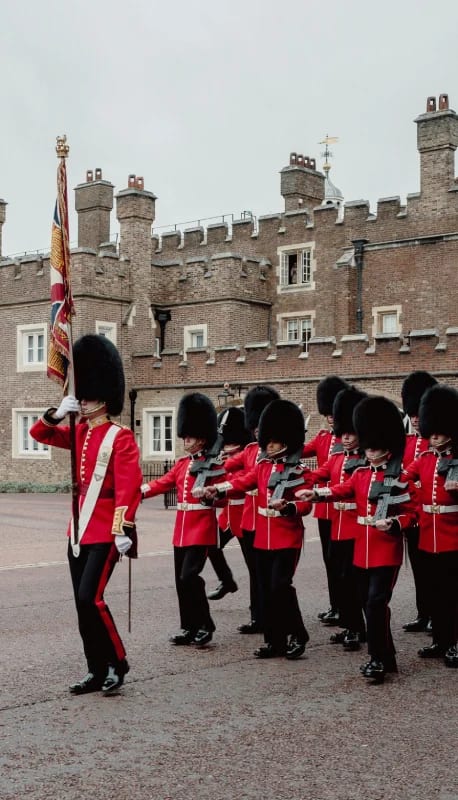
Stand on the pavement opposite St James's Palace near the Queen Alexandra Memorial at around 11:35am. At approximately 11:43 to 11:45am, the New Guard detachment arrives from Buckingham Palace, frequently led by the regimental band, for the final stage of the handover.
There are no railings. There are no barriers between you and the action. The crowds are a fraction of those at Buckingham Palace. Soldiers march directly toward you, the band performs, and the handover takes place in the open street twenty feet in front of where you are standing. You will hear the commands. You will see the faces. You will be able to photograph without fighting through a wall of phones.
This is the best free moment of the entire morning, and almost nobody is there.
Arrive at St James's Palace by 11:35am and stand on the pavement opposite, not pressed against the railings. The detachment approaches from Marlborough Road — you want to see them coming.
What the Full Ceremony Covers
St James's Palace is one of six stops that span the full morning. The ceremony starts well before most Buckingham Palace spectators arrive: the Old Guard inspection at Friary Court, a Tudor courtyard inside St James's Palace that almost no visitor ever sees. The New Guard assembles at Wellington Barracks. There is a procession along the Mall. A separate, nearly crowd-free guard change takes place at Clarence House. The Household Cavalry changes guard at Horse Guards Parade, which runs every day of the year and offers closer viewing of horses than anything at Buckingham Palace.
Horse Guards Parade also has a daily 4pm Dismount Parade that almost no guidebook mentions: an inspection in an open courtyard where you can stand feet from the horses with no barriers and no crowd.
Before You Go: Practical Tips
Check the schedule before you leave. The ceremony cancels more often than visitors expect, usually for heavy rain. The official Household Division calendar lists confirmed ceremonies and takes about ten seconds to check.
In warmer months the guards wear scarlet tunics and bearskin hats. From roughly November onward they may wear long grey greatcoats. If the classic uniform matters to you, late spring through early autumn is the safer window.
For Buckingham Palace and St James's Palace, the closest stations are Green Park (Jubilee, Victoria, Piccadilly lines) and St James's Park (District and Circle lines), both around eight to ten minutes on foot. For Horse Guards, Charing Cross (Bakerloo and Northern lines) is about five minutes. Do not drive — roads close before and during the ceremony.
The Changing of the Guard rewards those who know where to be before it starts. St James's Palace at 11:35am is the entire morning's best free moment — fewer crowds, closer views, no railings. Join our Westminster Free Walking Tour to experience it with context.