- 01The Route at a Glance
- 02Stop 1: Tottenham Court Road
- 03Stop 2: Denmark Street
- 04Stop 3: Soho Square Gardens
- 05Stop 4: Frith Street
- 06Stop 5: Greek Street
- 07Stop 6: Dean Street and the French House
- 08Stop 7: Old Compton Street
- 09Stop 8: St Anne's Churchyard
- 10Stop 9: Berwick Street Market
- 11Stop 10: Broadwick Street and the John Snow Pump
- 12Stop 11: Carnaby Street
- 13Stop 12: Kingly Court
- 14Final London Insiders Tip
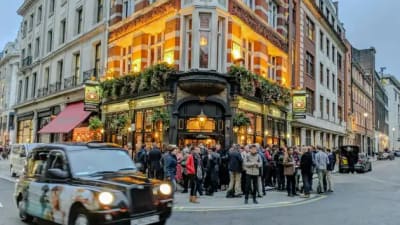
Soho is among London's most historically layered neighbourhoods. This self-guided route covers twelve stops across roughly 1.5 miles and takes around two hours at a relaxed pace. It starts at Tottenham Court Road and ends at Kingly Court, where you can continue into the evening without having to go anywhere else.
London Insiders also runs a free guided version of this walk with local guides who know the stories behind the buildings. The self-guided route covers the same ground but at your own pace. If you want the full story on the neighbourhood first, our Soho History guide is the best starting point. And if you're planning a night in the area, our Soho at Night guide covers where to go after the walk ends.
The Route at a Glance
Start: Tottenham Court Road station
Finish: Kingly Court, Carnaby Street
Distance: approximately 1.5 miles
Time: 90 minutes to 2 hours
Terrain: completely flat, fully accessible
Stop 1: Tottenham Court Road
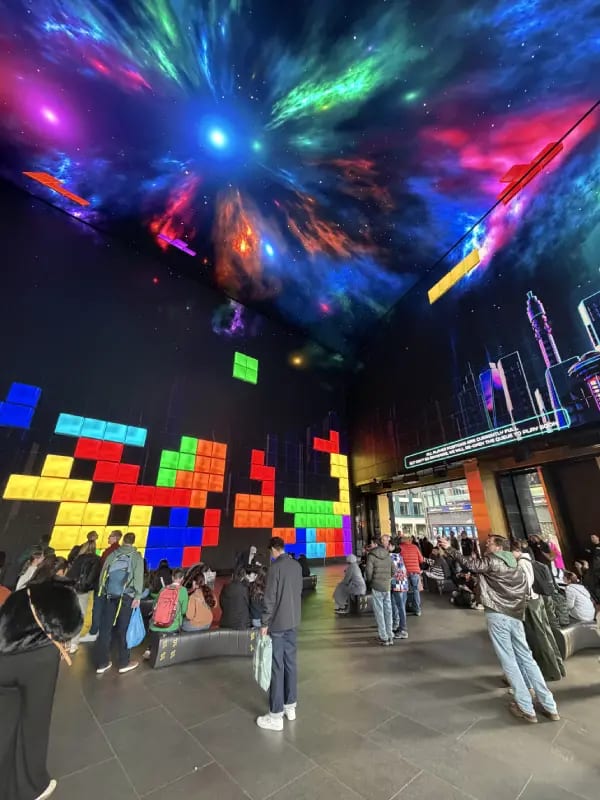
Exit Tottenham Court Road station and walk to the Charing Cross Road junction. The Outernet development on your right — opened in 2023 — has one of the largest wrap-around screens in Europe. It's worth one minute of your time before you turn into the side streets.
Stop 2: Denmark Street
Denmark Street sits technically just beyond Soho's formal boundaries but earns its place on this route entirely. The Rolling Stones recorded their debut album in a studio at number 4. The Sex Pistols rehearsed in the basement of number 6. David Bowie, Elton John and Donovan all had connections to this street during the 1960s and 70s. Most original buildings are still standing, and some of the vintage music shops survive.
At the far end of the street, look for the deliberately preserved graffiti on wooden hoardings. It dates back decades. It's one of the few examples of genuinely layered street history in central London that hasn't been painted over.
Stop 3: Soho Square Gardens
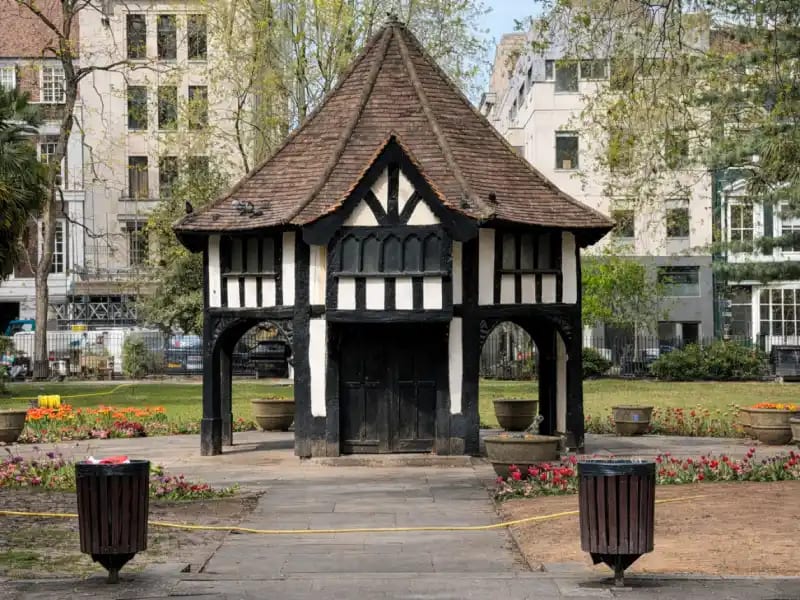
Soho Square Gardens is one of central London's oldest formal gardens, dating from 1681. The Tudor-style timber hut in the centre was originally built as a storage shed for a gardener's tools. Rumours about a World War II air raid shelter underneath have circulated for decades.
The statue of Charles II at the northern end of the square tells you something about the neighbourhood's history: Soho was once fashionable royal territory. When wealthy residents moved west to Mayfair in the eighteenth century, the neighbourhood transformed into something more interesting.
Stop 4: Frith Street
Frith Street runs south from Soho Square and contains more historical significance per metre than most London streets manage across their full length.
Number 20 has a blue plaque marking Wolfgang Amadeus Mozart's residence. He stayed here during 1764 and 1765, aged eight, while his father brought him to London to perform for aristocratic audiences. John Logie Baird demonstrated television for the first time in public in a first-floor room above what is now Bar Italia in January 1926. John Snow, whose work on the 1854 cholera outbreak revolutionised public health understanding, previously lived on this street.
Bar Italia at number 22 has been open since 1949. The Polledri family still runs it. The espresso is made properly. Rocky Marciano's portrait has been on the wall since before most people now drinking there were born. It is open until 5am. Ronnie Scott's Jazz Club operates at number 47. It opened in 1959. Miles Davis played here. Jimi Hendrix's final concert before his death was performed here in September 1970. It still runs seven nights a week.
Stop 5: Greek Street
Turn right from Frith Street onto Old Compton Street briefly, then head up Greek Street. The Coach and Horses at number 29 was the regular haunt of journalist Jeffrey Bernard for decades. Playwright Keith Waterhouse turned his columns about drinking here into a play, "Jeffrey Bernard is Unwell." It is still small, still uncomfortable, and still refuses to modernise.
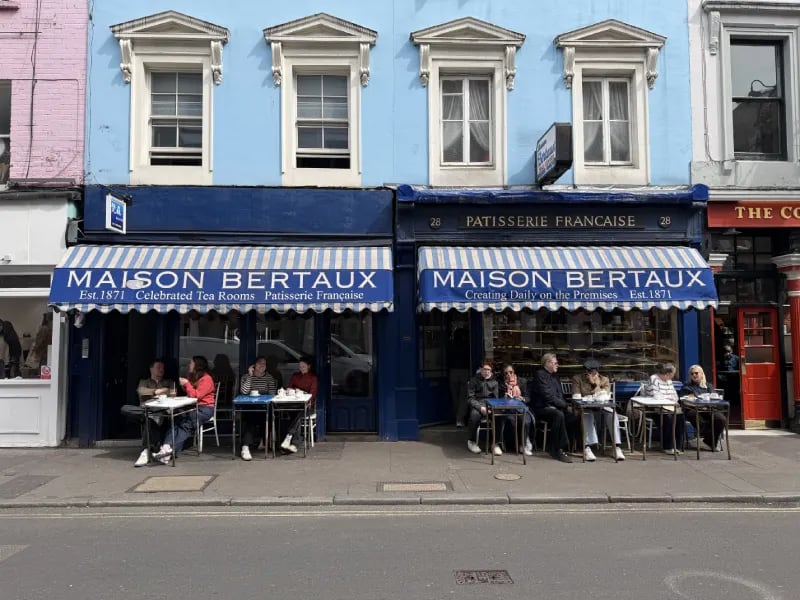
Maison Bertaux at number 28 is London's oldest patisserie, open since 1871. A French Communard refugee founded it. The cakes are the point. Afternoon tea runs between 3pm and 5pm. The upstairs room feels entirely disconnected from the century outside.
Stop 6: Dean Street and the French House
Head down Greek Street, turn onto Romilly Street heading west, and continue to Dean Street. The French House is at number 49. It has been a Soho institution since World War I, when it served as a refuge for French expatriates. Charles de Gaulle used it as an informal meeting place during the Second World War. Dylan Thomas, Brendan Behan and Francis Bacon were later regulars. Bacon bought rounds for the entire pub after selling paintings and borrowed money during leaner periods. The French House serves wine only. No pints. No exceptions. That single fact tells you more about the venue than any description could.
Stop 7: Old Compton Street
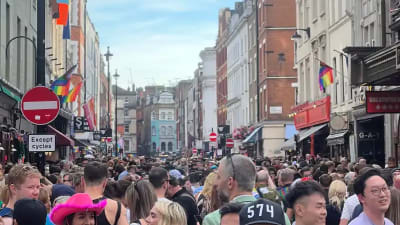
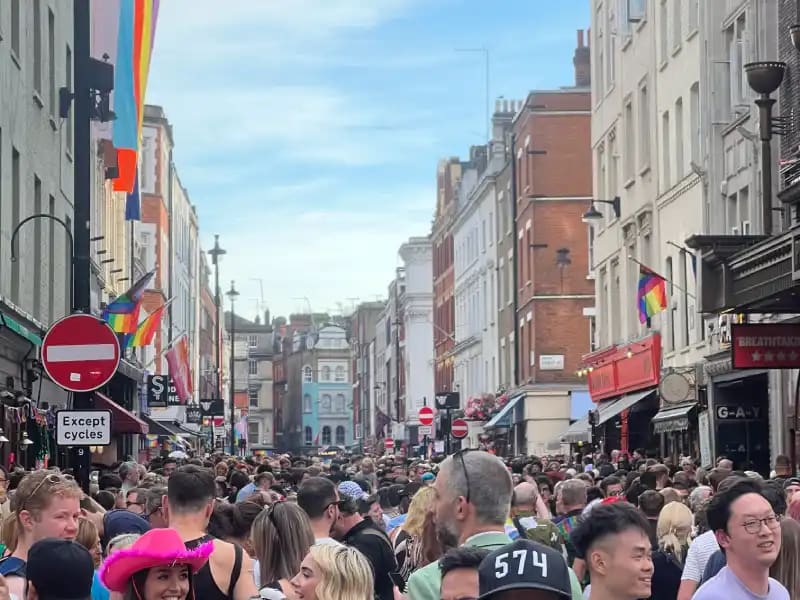
Old Compton Street has been the centre of London's LGBTQ+ community since the 1980s and 90s, when Soho became a gathering point during a historically significant period. The Admiral Duncan at number 54 deserves acknowledgement. A nail bomb detonated here in April 1999, killing three people and injuring seventy. It was the third in a series of targeted bombings across London that month. The pub rebuilt and reopened. There is a memorial inside. Old Compton Street also opened one of London's first coffeehouses in the seventeenth century. This is one of the most photographed sections of the walk.
Stop 8: St Anne's Churchyard
Head south from Old Compton Street onto Wardour Street and find the entrance to St Anne's Churchyard on your right. Bombing during the Blitz largely destroyed the church itself, leaving a small and genuinely quiet garden. Crime writer Dorothy L. Sayers, known for the Lord Peter Wimsey detective novels, is buried here. She was born in the parish. Her ashes were interred in the church tower. It is an easy stop to skip on a busy route but provides one of the few genuinely quiet moments in the neighbourhood.
Stop 9: Berwick Street Market
Head north on Wardour Street, turn left onto Broadwick Street and right onto Berwick Street. Berwick Street Market has operated here since the early 1800s — one of the last surviving street markets in central London. Stalls offer fruit, vegetables and street food. It is best before noon, before the lunch crowds arrive. The street appeared on the Oasis album cover for "What's the Story Morning Glory" in 1995. The two figures walking toward each other are not band members — one was the art director, the other a friend of the photographer.
Two coffee alternatives nearby are worth noting. The Algerian Coffee Stores on Old Compton Street is London's longest continuously operating coffee shop, with flat whites around £2 — exceptional for central London. Hideaway Coffee House, in a small courtyard nearby, is quieter and best visited before the morning rush.

Stop 10: Broadwick Street and the John Snow Pump
Continue east on Broadwick Street after the market and find a water pump replica outside the John Snow pub at the corner of Broadwick Street and Poland Street. In 1854 a cholera outbreak killed over 600 Soho residents in weeks. John Snow, who had previously lived nearby, mapped each death against its location and traced the source to a single water pump on this street. He persuaded local authorities to remove the pump handle. Deaths stopped. Snow's method of tracing disease back to a source eventually underpinned modern infectious disease understanding. The pump is a replica — the original was removed in the 1850s. A blue plaque marks the precise location. Most people walk past without noticing. This is one of the route's most historically significant stops.
Stop 11: Carnaby Street
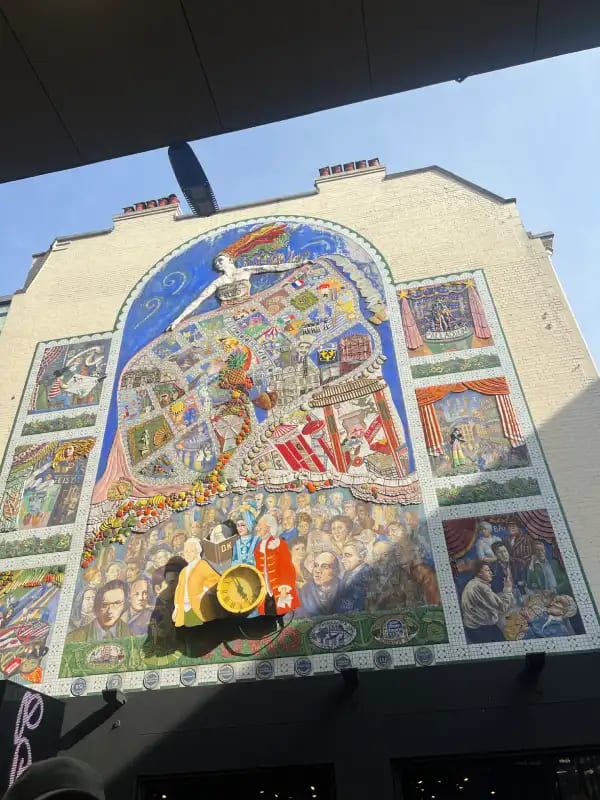
Head south from Broadwick Street onto Carnaby Street. The street became 1960s London counterculture shorthand and has made the most of that reputation since. It works better on warm afternoons than grey weekday mornings. At the corner of Carnaby Street and Ganton Street, look for the Spirit of Soho mural, created in 1991 by local artists. It depicts Soho figures across several centuries — Georgian and Victorian characters alongside twentieth-century faces. Most people walk past it without looking up.
Stop 12: Kingly Court
The walk ends at Kingly Court, through an archway off Carnaby Street. This three-level courtyard contains restaurants and bars with terrace seating at each level. It is a natural place to stop, particularly if you are doing this walk in the late afternoon and want to continue into the evening.
Flat Iron on nearby Beak Street does the best-value steak in this part of London. No reservations, quick turnover, order the creamed spinach. Dishoom on the ground floor of Kingly Court is a reliable choice for a longer late lunch. Cahoots is a 1940s tube carriage-themed cocktail bar in a former air raid shelter beneath the street — committed to the theme in a way that either appeals immediately or doesn't. Ain't Nothing Blue on Kingly Street has been London's original blues bar since 1993. Live music every night, small venue, fills quickly.
Final London Insiders Tip
Soho rewards slow walking. The things worth noticing are rarely the famous landmarks — they are the details at eye level and the stories behind unremarkable-looking doors. Allocate more time than you think you need. And if you'd rather do this walk with a local guide who can fill in the parts that no self-guided route can fully cover, our Soho Free Walking Tour runs on Friday afternoons.
The route covers approximately 1.5 miles from Tottenham Court Road to Kingly Court. At a relaxed pace with brief stops, allow 90 minutes to two hours. Adding coffee or food stops extends the time.
Yes. The route follows flat, paved streets throughout, with no steps or significant inclines. All stops are publicly accessible and the route is suitable for pushchairs and wheelchairs.
Weekday mornings are quietest. Berwick Street Market is best before noon. Old Compton Street and Carnaby Street have more atmosphere on weekend afternoons. Avoid Saturday evenings after 7pm if you want to move freely.
Every stop is free. Bar Italia, Maison Bertaux and Kingly Court are optional spending points but nothing on the route requires you to spend anything.
The route starts at Tottenham Court Road station and ends at Kingly Court on Carnaby Street. Both have excellent public transport connections.